
.svg)
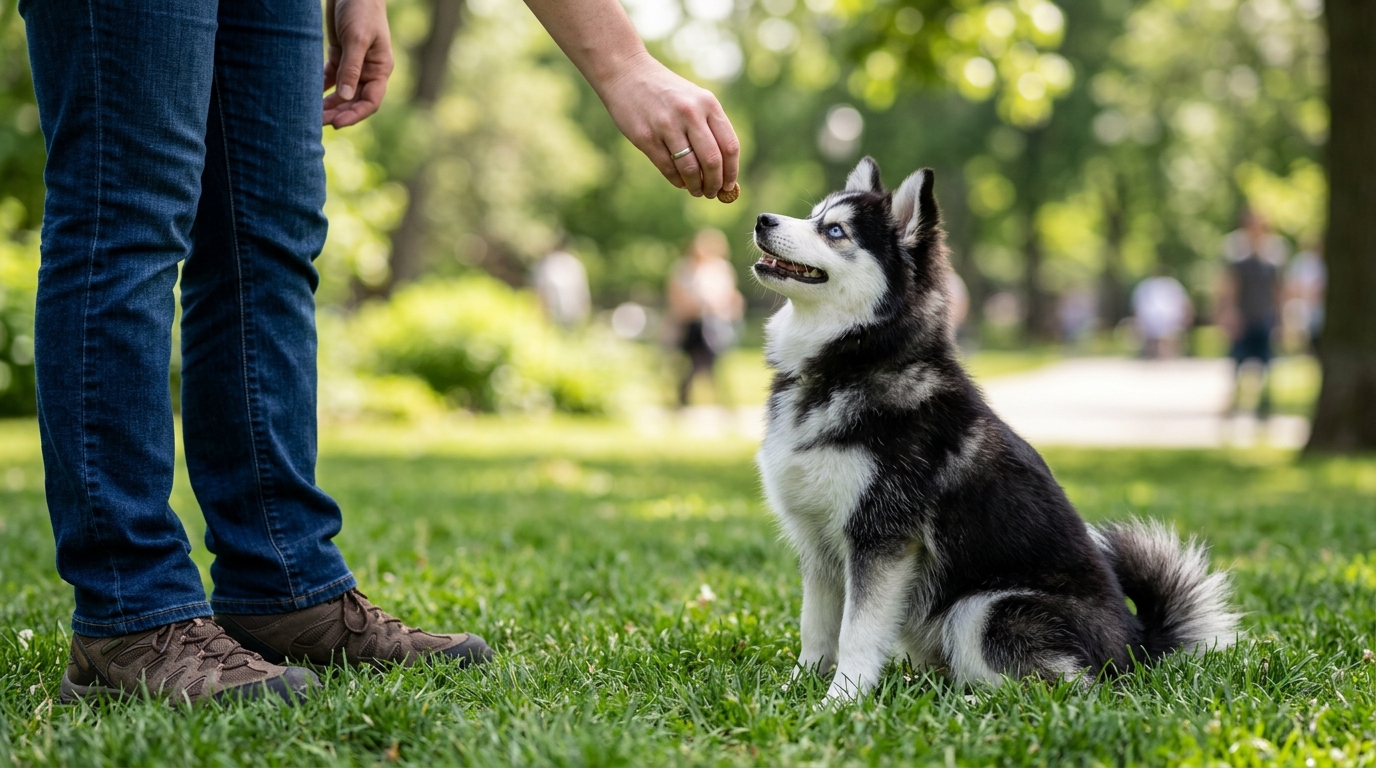
Pomskies are clever and quick to learn, but their independent, sometimes stubborn streak can make training feel like a battle of wills. It does not have to be. The most effective and humane way to train any Pomsky, no matter how stubborn, is to work with how dogs actually learn rather than trying to dominate them.
Here are five tips:
Tip 1: Lead With Reward-Based Training
The foundation of good training is simple: reward the behaviors you want, and your Pomsky will repeat them. When your dog sits, comes when called, or settles calmly, mark the moment (a quick "yes" works well) and follow it with something they value, such as a treat, a toy, praise, or the chance to keep sniffing. Over time your Pomsky learns that listening to you pays off.
This is not just the kind approach, it is the effective one. The American Veterinary Society of Animal Behavior recommends reward-based methods and advises against training that relies on fear, pain, or intimidation. It also means letting go of the old "pack leader" or "dominance" idea. That theory has been set aside by modern behavior science. Your Pomsky is not plotting to run the household, they are simply doing what works for them. Change what works, and you change the behavior.
Tip 2: Learn to Read Your Pomsky
Dogs constantly tell us how they feel through body language, and a Pomsky who is stressed, overexcited, or frightened cannot learn well in that state. Watch for the signs: a stiff body, a hard stare, lip licking, yawning, pinned ears, a tucked tail, or a dog that suddenly cannot take a treat or hear your cues.
Think of your Pomsky's arousal like a dial. When they are calm, they can think and learn. Once they tip past their threshold into full excitement or fear, their fight-or-flight response takes over and training simply stops working. The skill is to notice your dog climbing that dial early and ease off before they boil over. Train in the calm zone, and everything else gets easier.
Tip 3: Keep Your Pomsky Calm and Under Threshold
When something sets your Pomsky off, another dog, a passing cyclist, or the doorbell, your instinct may be to tug the leash and repeat "leave it" louder. That usually adds tension and makes things worse, because your dog mirrors your energy.
Instead, manage the distance. The moment you notice your Pomsky starting to react, calmly move further away from whatever is triggering them until they can focus again, then reward them for checking back in with you. This builds a calmer association over time and works far better than trying to correct a dog who is already over the edge. Stay relaxed yourself, keep your voice low and steady, and give your Pomsky room to settle. Avoid any technique that works by startling, pinning, or intimidating your dog.
Tip 4: Redirect and Reward Instead of Punishing
Here is a truth that catches many owners out: attention is a reward, even negative attention. When your Pomsky jumps on the couch or barks for you and you shout, chase, or push them off, you may be handing them exactly what they wanted. Punishing after the fact does not work either, because dogs do not connect a scolding with something they did minutes ago.
The better approach is to prevent the behavior where you can, withhold attention for the behavior you do not want to encourage, and reward the behavior you do. Teach and reinforce an alternative, like four paws on the floor or settling on a mat. If a behavior is purely attention-seeking, calmly removing your attention for a moment and then rewarding calm teaches far more than any telling-off.
Tip 5: Manage the Environment to Set Up Success
You cannot train a Pomsky you cannot reach, and you cannot fix a behavior that keeps getting rehearsed. Managing the environment means arranging things so the right choice is easy and the wrong one is hard. If your Pomsky counter-surfs, keep food off the counter while you teach an alternative. If guests trigger jumping, use a gate or a leash.
For recall, a long training line is your best friend. Clip a light line, anywhere from a few feet to many yards long, to the harness and let your Pomsky explore while you keep the ability to guide them back. It gives freedom safely while recall is still a work in progress. Management is not a crutch, it is a recognized part of humane training that gives your dog more chances to get it right.
Final Thoughts
Training any Pomsky, even a stubborn one, comes down to this: reward what you want, read your dog, keep them calm enough to learn, skip the punishment, and set the stage for success. Be patient and consistent, and your Pomsky will start choosing to work with you. For a deeper dive, see our full guide to the training method that works for Pomskies.



.svg)
.svg)